Main · Spring · Summer · Intermediate
Whole Roasted Branzino with Salsa Verde
with Shaved Fennel, Lemon & a Bunch of Parsley
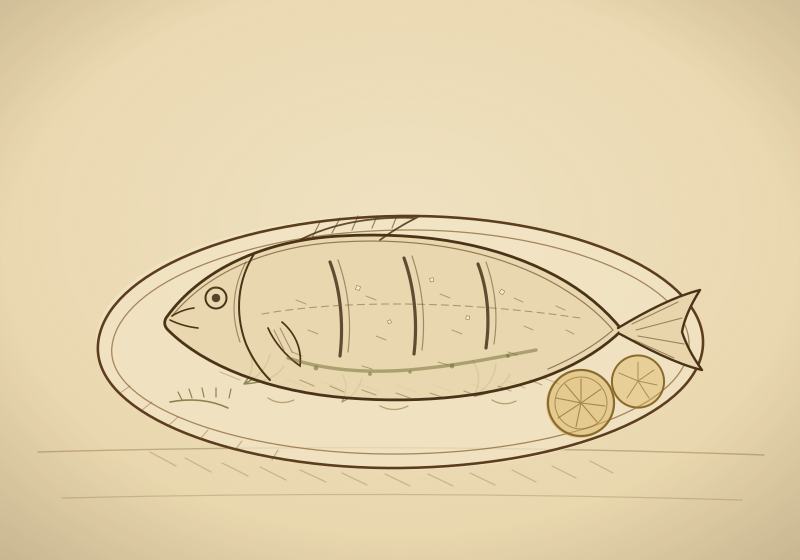
Blistered, salt-crisped skin over pearlescent flakes that lift clean off the bone, roasted on a bed of anise-sweet fennel and finished with a bright green ribbon of salsa verde.
Per serving ≈ 560 cal · 43g protein · 39g fat · 9g carbs
Two branzino, a fennel bulb, and a bunch of parsley are about all the fish counter and the herb pots can spare on a July evening at the lake. Cooking the fish whole is the lazy cook's insurance policy — the skeleton and skin do the work of keeping the flesh from drying while you pour the wine. The salsa verde is chopped on the same board the fish was cleaned on, and by the time the platter hits the table nobody remembers it took twenty minutes. (Story is a plausible lodge scene, not a documented event — see notes.)
Cooking around dairy, gluten, wine, meat…? tap to adjust
The Tools
- Rimmed sheet pan or shallow roasting pan — Big enough for two whole fish not touching
- Cutting board
- Chef's knife — Also does the parsley — wipe between fish and herbs
- Kitchen shears — Trim fins and finish the gill removal if the counter didn't
- Fish tweezers or clean needle-nose pliers — For pin bones — a regular tweezer is too weak
- Small pot (hard-boil the egg) (optional)
- Mixing bowl (salsa verde)
- Two spatulas or one wide fish spatula (moving and plating the fish) — A whole cooked fish tears if you lift it one-handed
- Warmed serving platter
- Instant-read thermometer (optional) — The most honest doneness check there is
- Microplane or zester (lemon) (optional)
- Fish scaler (optional) — Only if the counter didn't scale it; the sink gets messy
✚ ends up in the sink · essentials unless marked optional
Salsa Verde
Why this works The plate's acid-and-salt engine, and the reason a lean fish never reads as plain. This mirrors the standalone salsa-verde recipe — see it for the mint, tarragon and cornichon variations — but built lean here so the parsley stays loud. Chop it by hand, not in a food processor: the blade bruises parsley into a dark, bitter, pasty sludge, where a knife leaves a green, glistening relish with texture. The anchovy melts into savory depth (it is glutamate, not fishiness — no one at the table names it), and it plus the capers do all the salting, so you taste before you ever reach for the salt cellar. Mustard and a little mashed egg yolk are emulsifiers: they hold the oil suspended so the sauce stays a spoonable relish instead of splitting into a green puddle and an oil slick on the plate. Vinegar goes in last and close to serving — acid over time turns the bright green a tired olive-drab.
- 1 large bunch (~60g leaves + tender stems) Flat-leaf parsley — Curly parsley bruises and turns bitter — flat-leaf only
- 2 tbsp, soaked and rinsed Salt-packed capers — Brined capers work; rinse them too, and expect less depth
- 4 fillets, drained Oil-packed anchovy fillets — The umami spine of the sauce — buy good ones. No fish-free swap exists here; the whole dish is fish (see incompatible).
- 1 small clove, pounded to a paste with a pinch of salt Garlic
- 1 tsp Dijon mustard
- 1, mashed smooth Hard-boiled egg yolk — Optional but traditional — rounds and emulsifies. Leave it out for a sharper, leaner sauce.
- 1/2 cup (120ml), good and grassy Extra virgin olive oil — This is most of the sauce — use oil you would drink
- 1 tbsp, added at the end Red wine vinegar
- a squeeze to finish Lemon — Optional — a little lifts it further
- to taste Black pepper
-
Boil the yolk (if using) 3 min hands-on · 9 min wait
Lower one egg into boiling water, cook 9 minutes, shock in cold water, peel. Reserve the yolk; save the white for a snack.
Look for Yolk set through and pale-gold, no wet green ring.
-
Prep the salty bits 5 min hands-on · 5 min wait
Soak salt-packed capers 5 minutes, rinse, pat dry. Drain the anchovies. Pound the garlic to a smooth paste with a pinch of salt.
-
Chop by hand 6 min hands-on
Gather parsley, capers and anchovies into a pile and rock the knife through them until finely chopped and uniform — a minute or two of real chopping.
Look for A loose, fluffy green mince, not a wet paste — you can still see distinct parsley flecks.
Take care Do not reach for the food processor. It bruises the parsley to a bitter, dark sludge — the single most common way this sauce is ruined. -
Build the relish 4 min hands-on
Scrape the mince into a bowl with the garlic paste, Dijon and mashed yolk. Stir in the olive oil in a slow stream until it comes together into a loose, glossy relish.
Look for The oil holds the solids in suspension; a spoon dragged through leaves a trail that fills back slowly.
-
Season, rest, taste 2 min hands-on · 20 min wait
Stir in the vinegar and a few grinds of pepper. Taste before adding any salt — the capers and anchovy usually have it covered. Rest 15–30 minutes for the flavors to marry.
Look for Tastes bright, savory, herbal, with a sharp acid finish that clears the palate.
Take care Add the vinegar too early and the parsley grays within the hour — keep the vinegar for close to serving if you make the base ahead.
When it goes wrong
| Problem | Cause | Fix |
|---|---|---|
| Dark, bitter, pasty | Blitzed in a processor instead of hand-chopped | No rescue — remake it with a knife |
| Split into herbs and an oil slick | Oil added too fast or no emulsifier | Whisk in an extra 1/2 tsp Dijon or a few drops of cold water |
| Flat and dull | Shy on anchovy, capers or acid | One more chopped anchovy, then vinegar and pepper by the drop until it snaps |
Whole Roasted Branzino
Why this works Roasting the fish whole is the whole trick. The intact skin and the layer of fat just beneath it insulate the flesh, and the dense skeleton at the core stays cooler than the meat around it — bone is a heat sink here, not a conductor driving heat inward — so a whole fish holds moist at 130–135°F where a naked fillet would already be cottony at the thin edges. Score the skin in shallow diagonals: the cuts render the fatty skin toward crisp, keep it from curling and tearing as it tightens, and let salt and heat reach the flesh. Salt the skin AND the cavity — the cavity is most of the seasoning surface on a whole fish. The bed of shaved fennel does three jobs: it lifts the fish off screaming-hot metal so the skin browns instead of scorching, it catches and re-steams the rendered oil and fish juices, and it collapses into a built-in, anise-sweet side. FOOD SAFETY: the FDA target for fish is 145°F; a chef pulls whole fish at 130–135°F for silky flakes and serves it straight away. If you want the FDA number, pull at 140–145°F and accept a firmer, drier flake — the choice is yours, but make it knowingly and never hold cooked fish warm for long. THE INGREDIENT IS THE CEILING: no roast rescues a tired fish, so buy it right (clear domed eyes, bright red gills, flesh that springs back, a smell of clean seawater and nothing more).
- 2 fish, 1–1.25 lb (450–570g) each, scaled, gutted, gilled, fins trimmed Whole branzino — Also sold as European/Mediterranean sea bass or loup de mer. This is the dish — no substitution (see incompatible). A whole trout or small snapper roasts on the same clock if branzino is unavailable.
- 1 large, shaved thin, fronds reserved Fennel bulb — Reserve the feathery fronds for the cavity and the plate
- 2 — one sliced thin, one cut into wedges Lemons
- 6 sprigs Fresh thyme
- a few sprigs (cavity) Flat-leaf parsley
- 2 cloves, smashed (cavity) Garlic
- 3 tbsp (skin and fennel bed) Extra virgin olive oil
- generous — skin and cavity of both fish Kosher salt
- to taste Black pepper
- finishing Flaky salt (Maldon)
-
Check and dry the fish 6 min hands-on
Confirm the belly is clean and the gills are gone; snip off any sharp fins with shears. Rinse briefly and pat bone-dry inside and out with paper towels.
Look for Skin dry and slightly tacky, cavity dry to the touch — surface water is the enemy of crisp skin.
Take care A wet fish steams and the skin never crisps. Dry it far more thoroughly than feels necessary, cavity included. -
Heat the oven 1 min hands-on · 10 min wait
Oven to 450°F (230°C), convection if you have it. No need to preheat the pan.
-
Lay the fennel bed 5 min hands-on
Toss the shaved fennel with 1 tbsp oil and a pinch of salt; spread it in two fish-shaped beds on the sheet pan.
Look for An even, single-ish layer — enough to lift the fish, not a thick mattress that steams it.
-
Score and season 4 min hands-on
Cut 3 shallow diagonal slashes into each side, down to the bone but not through it. Salt the skin and the cavity generously; pepper the skin.
Look for Cuts about 1/2 inch apart, angled — you can see the flesh open slightly.
Take care Slashing through to the far skin makes the fish fall apart on the platter. Stop at the backbone. -
Stuff and oil 4 min hands-on
Fill each cavity with lemon slices, thyme, parsley, a smashed garlic clove and a few fennel fronds. Rub the skin with the remaining 2 tbsp oil and settle each fish on its fennel bed.
-
Roast 1 min hands-on · 20 min wait
Roast at 450°F for 18–25 minutes depending on size, until the skin blisters and the thickest flesh behind the head reads 130–135°F.
Look for Skin taut, blistered and lightly browned along the score lines; the cavity smells of lemon and roasted fennel.
Take care Ovens lie by 25°F both ways — start checking at 16 minutes for smaller fish, and trust the thermometer over the clock. -
Check doneness three ways 2 min hands-on
Slide the thermometer into the thickest part behind the head, off the bone: 130–135°F. Cross-check by hand — the flesh at the spine is opaque white and lifts cleanly off the backbone, and the dorsal fin (the long one on top) pulls straight out with no resistance.
Look for Flesh opaque and pearlescent, separating from the bone in moist flakes; a fin that fights back means it needs a few more minutes.
Take care Past ~140°F the flesh turns dry and chalky — you cannot walk that back. Pull early and let carryover finish it. -
Rest 1 min hands-on · 4 min wait
Rest the fish on the pan 3–5 minutes. Carryover carries it the last couple of degrees while the juices settle.
Look for Juices in the pan turn from cloudy to clear.
-
Fillet and pin-bone 6 min hands-on
Run the knife along the top of the backbone and lift the top fillet free; peel the whole skeleton up from tail to head to clear the bottom fillet. Run a fingertip up the center of each fillet — the pin bones sit in a row along the lateral line — and pull any you feel with fish tweezers, angled toward the head, the way they lie.
Look for Fillets come away in two clean pieces; a fingertip drawn along the flesh meets no needles.
Take care Yank pin bones straight up and they tear the flesh and often snap — pull along their angle, toward the head.
When it goes wrong
| Problem | Cause | Fix |
|---|---|---|
| Skin steamed and flabby, not crisp | Fish went in wet, or the fennel bed was too thick and dammed the steam | Dry far harder next time; keep the bed thin; finish 2 minutes under a hot broiler to blister the skin |
| Dry, chalky flesh | Overcooked past ~140°F, or the fish was too small for the time | Pull at 130–135°F and lean on carryover; spoon extra salsa verde over to bring it back to life |
| Fish tore apart lifting it | Scored through both sides, or lifted with one spatula | Score only to the backbone; move it with two spatulas or serve it filleted from the pan |
To the Table
Warm the platter (a few minutes in the cooling oven).
Rake the roasted fennel into a low bed down the center of the platter.
Lay the fish — whole for the table, or filleted skin-up — on the fennel.
Spoon salsa verde in a ribbon down the length of the fish, about 2 tbsp per portion; keep the rest in a bowl on the table.
Lemon wedges alongside, a last thread of good olive oil, a pinch of Maldon over the skin. Serve at once, while the skin still crackles.
For the Cook Who Wants More
The Honest Ledger
| Serves | 2 |
|---|---|
| Shopping | 45 min |
| Hands-on (new to this) | 1 h 20 min |
| Hands-on (comfortable) | 1 h 3 min |
| Hands-on (experienced) | 50 min |
| Waiting (same for everyone) | 1 h 8 min |
| True total | 2 h 43 min |
| You will dirty | 11 dishes |
The leanest of proteins under one of the cleanest fats: the fish itself is ~4g fat, and nearly all of the 39g is olive oil (roasting oil plus the oil-forward salsa). The salsa verde IS the acid and salt relief valve — do not skip it. Two whole fish serve two as a main, one per person; fillet both to plate four lighter portions inside a larger menu. FODMAP note: garlic carries an infused-oil swap, but a large portion of fennel bulb (over ~80g) is moderate-to-high FODMAP on its own — sensitive readers should keep the fennel to a small side.
Words We Used
- Branzino
- European/Mediterranean sea bass, also loup de mer — a mild, lean, sweet white fish sold whole at about 1 lb, ideal for roasting on the bone.
- Salsa verde
- Italian green sauce — parsley, capers, anchovy, garlic and oil chopped into a bright, spoonable relish; the classic partner to poached and roasted fish.
- Pin bones
- The fine row of bones running along a fillet's lateral line, separate from the skeleton; found by fingertip and pulled with tweezers at the angle they lie.
- Scoring
- Shallow diagonal cuts through the skin to the bone that help fatty skin render and crisp, keep it from curling, and let salt and heat reach the flesh.
- Carryover
- The cooking that continues after the fish leaves the oven — worth a couple of degrees, which is why you pull at 130–135°F and rest.
- Pareve
- In kosher-style cooking, a food that is neither meat nor dairy. Fish is pareve, so this dish carries no meat-and-dairy conflict.